Blog
How Automotive Aftermarket Leaders Are Winning
With Better Product Data

Content
The Independent Automotive Aftermarket (IAM) is more demanding and fast-moving than ever before. Where the IAM was once defined by physical parts distribution and personal relationships, the market has since shifted significantly into the digital space.
On top of this digital transformation, independent parts manufacturers and distributors are facing a new set of major challenges. Vehicles are becoming “computers on wheels,” routing their data exclusively back to OEMs. At the same time, e-commerce giants are driving up price pressure, while the technical complexity of EVs, advanced driver assistance systems (ADAS), and sensor technology continues to accelerate.
In this environment, having the best products is no longer enough to win. The real competitive advantage belongs to whoever can deliver the right information, at the right time, at the right point of sale.
1. The IAM — A Market With Its Own Data Logic
The Automotive Aftermarket operates under fundamentally different rules than most other B2B industries. Companies in the IAM aren’t simply selling standalone products — they’re selling the right solution for a specific vehicle. That means every part needs to be matched to the right make, model, engine, production year, and variant.
This fitment logic creates an exceptionally high level of data complexity:
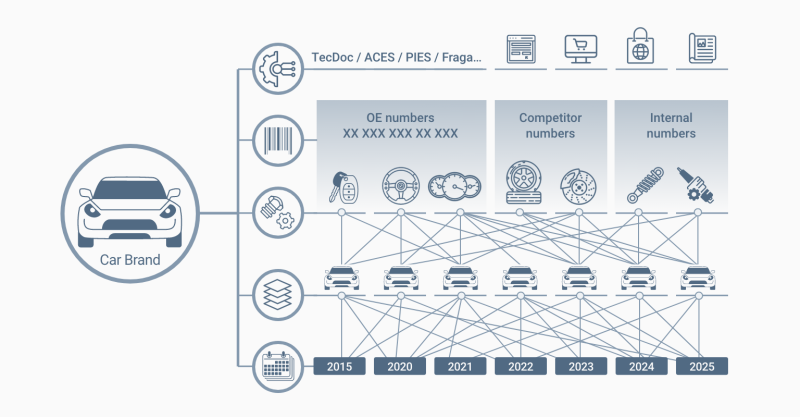
Errors in this data have immediate business consequences. Incorrect vehicle fitments drive up returns, missing attributes prevent products from being listed in the first place.
The result is customer dissatisfaction, financial loss, and — in the worst case — serious safety risks.
Beyond product complexity, vehicle market conditions are shifting faster than ever, demanding quicker response times across the board.
That challenge is compounded by the fact that most companies have their product information scattered across multiple disconnected systems:

Given this combination of growing data complexity and fragmented product information, it’s clear that manual processes have long since hit their limits.
2. Cross-Functional Platforms as a Driver of Operational Efficiency
eyond data complexity, the Automotive Aftermarket is defined by a high degree of uncertainty. Supply chains shift, product portfolios expand, and the requirements of customers, marketplaces and data ecosystems are in constant flux.
In this kind of environment, adaptability becomes a core organizational capability. But adaptability doesn’t come from individual point solutions — it comes from cross-functional platforms that enable shared processes, unified data models, and consistent governance.
These platforms consolidate core functions, eliminate redundancies, and create the foundation for scalability. They enable version control, content reuse, and clear oversight across business units. By leveraging shared systems and interfaces, organizations can meaningfully reduce complexity rather than just redistribute it.
According to Roland Berger, however, this potential frequently goes unrealized in practice. Legacy silo structures persist, and shared governance is often missing entirely. In the automotive supplier industry, only 7% of companies have reached a mature level of platform adoption. And the cost of those silos goes beyond lost flexibility — they actively prevent organizations from capturing the full benefits of platform-based data management, including version control, scalability, and cross-functional efficiency.
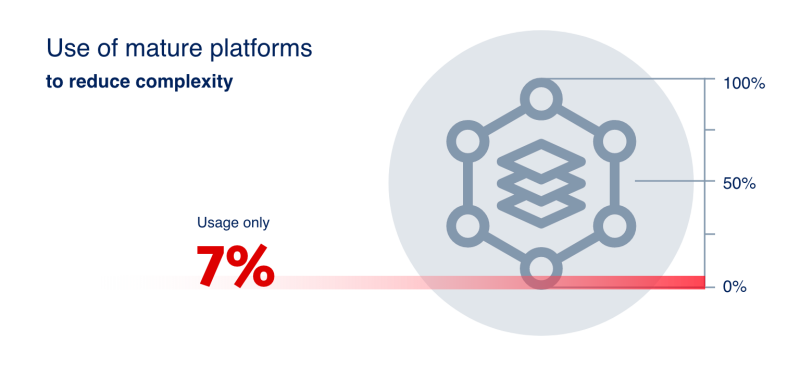
To compete in a volatile IAM, companies must make the move to cross-functional platforms a strategic priority — not a future initiative.
2.1 Why a PIM System Is Essential in the Aftermarket
For the IAM, one of the most impactful cross-functional platforms a company can invest in is a Product Information Management (PIM) system. In the Automotive Aftermarket, a PIM isn’t an optional add-on — it’s a structural necessity.
A PIM system serves as:
A PIM system, therefore, does far more than manage product information. As a central business platform, it actively contributes to value creation across the organization.
2.2 Why a Standard PIM Isn’t Enough
A PIM acts as a single source of truth — centralizing data and eliminating silos. But the Automotive Aftermarket has a defining characteristic that sets it apart: vehicle fitment logic.
Standard PIM systems are generally well-suited to managing attributes like color or size. Where they fall short is in handling the depth and complexity of automotive data standards. That gap makes the case clear: IAM companies need an industry-specific PIM built for the way their business actually works.
Choosing a PIM system in the Automotive Aftermarket is far more than an IT decision. It’s a strategic commitment that shapes the future direction of the business. Because winning in the IAM takes more than a generic product data tool — it requires a platform purpose-built for the unique demands of this industry.
3. Comparing PIM Approaches in the Automotive Aftermarket
3.1 AutomotivePIM: The Specialized PIM for the IAM
AutomotivePIM is a PIM solution built specifically for the Independent Automotive Aftermarket. The focus isn’t simply on managing product information. AutomotivePIM comes with a pre-configured data model designed around aftermarket logic from the ground up. As an industry-specific platform, product data, vehicle fitment logic, cross-references, variants, digital assets, and publishing capabilities are all integral parts of the system — not bolt-on additions.
Advantages
- Aftermarket logic is available out of the box, reducing modeling effort and project risk
- Faster time-to-value through pre-built industry logic and proven processes
- PIM and DAM are both natively integrated within AutomotivePIM
- Full omnichannel support, including print
Disadvantages
- Less versatile outside of the aftermarket context, as the platform is purpose-built for the IAM
- Limited modeling flexibility for use cases beyond the aftermarket
What Sets It Apart
AutomotivePIM isn’t a blank-canvas toolkit — it’s a solution with clear, domain-specific focus. IAM companies benefit most from a platform that already speaks their language, with built-in process logic tailored to the way the aftermarket actually operates.
3.2 Traditional PIM Systems: General-Purpose Product Data Management
Traditional PIM systems are industry-agnostic solutions designed to manage, enrich, and distribute product information across multiple output channels. Because of their neutral, horizontal design, industry-specific logic — such as automotive fitment rules or data standards — must be added through custom configuration, extensions, or additional third-party systems.
Advantages
- Single source of truth for centralized product information management
- Strong support for multiple languages, markets, and channels
- Established workflows for data maintenance, approvals, and quality assurance
Disadvantages
- No native support for complex Automotive Aftermarket logic
- Product-to-vehicle relationships, industry standards, and media dependencies must be custom-modeled
- Frequently requires additional DAM, publishing, or integration solutions to fill functional gaps
- Scaling effort increases significantly as data complexity grows
What to Keep in Mind
Traditional PIM systems are functionally powerful, but industry-agnostic by design. They perform very well in markets with straightforward product logic. In the Automotive Aftermarket, however, they can hit their limits quickly — unless they are deliberately extended and configured to meet the demands of the industry.
3.3 Open Source PIM Systems: A Flexible, Build-Your-Own Approach
Open source PIM systems are intentionally designed to be industry-agnostic — technically flexible and free of any predefined business logic. With open access to the source code, these platforms allow for deep customization and extension to fit virtually any use case.
Advantages
- High flexibility in data modeling and process design
- Large developer communities and broad partner ecosystems
- Strong integration capabilities with existing IT landscapes
Disadvantages
- No native Automotive Aftermarket logic or automotive data models included
- High modeling and ongoing maintenance effort
- Roadmap and further development depend on the vendor or implementation partner
- Automotive domain expertise is not embedded in the product — it must be built from scratch and continuously expanded
What to Keep in Mind
Open source PIM is a build-your-own toolkit that offers a great deal of freedom — but demands an equally high level of discipline. Because these systems are designed to be industry-neutral, deploying one in the Automotive Aftermarket raises the stakes considerably. Success depends heavily on bringing the right domain expertise to the table and maintaining it as the IAM continues to evolve.
Conclusion: Digital Sovereignty as a Competitive Advantage
The IAM is under pressure. Rapidly shifting vehicle market conditions and accelerating data complexity are reshaping the competitive landscape. For manufacturers and distributors who want to stay in the game, regaining digital sovereignty isn’t optional — it’s essential.
At the end of the day, a PIM system in the Automotive Aftermarket is not a nice-to-have. It’s a prerequisite for staying competitive. The real question is which approach best fits your data reality, organizational structure, and long-term strategy:
- AutomotivePIM — a platform purpose-built for the IAM, with industry logic built in from day one
- Traditional PIM solutions — industry-agnostic and flexible, suitable for organizations with the resources to customize
- Open source PIM systems — maximum flexibility and freedom, at the cost of higher implementation and maintenance effort
A specialized, cross-functional solution like AutomotivePIM by Bertsch Innovation is far more than a database. It serves as the digital backbone that enables IAM companies to successfully market and distribute their products — today and well into the future.
Source: Roland Berger “Future-proof automotive suppliers – Three imperatives for organizational success” 12/2025

Highlighted Whitepaper
ePaper: Automotive Aftermarket
Download onze automotive aftermarket e-paper en kom meer te weten over de dagelijkse uitdagingen van fabrikanten, werkplaatsen en serviceproviders.