Blog
Automotive Aftermarket 2026:
Future-Proof Processes for Modern Parts Distribution
From Carl Brenninkmeijer (CCO, Bertsch Innovation GmbH) & Sebastian Platz (Product Owner AutomotivePIM, Bertsch Innovation GmbH).
The automotive aftermarket is under mounting pressure. We see this every day in our conversations with our customers. Today’s informed, price-conscious buyers are squeezing OEMs and IAM suppliers alike. Companies that fail to master their product data will lose the race for workshop loyalty and end-customer share. This is no longer a prediction. This is the reality we face in 2026.
The New Reality in the Automotive Aftermarket
In our work with aftermarket companies, we repeatedly encounter four challenges—and they shape the entire market.
Challenge 1: Aging Vehicle Fleets & Price Sensitivity
The Simon-Kucher Global Automotive Study 2025, based on a survey of 6,780 car buyers across 20 markets, paints a clear picture: today’s vehicle buyer is more confident, better informed, and more price-sensitive than ever before. The implications reach far beyond the new-car market and extend deep into the automotive aftermarket.

Globally, 46% of consumers expect their purchasing power to decline.
At the same time, 54% plan to keep their current vehicle longer.
What does this mean?
- Vehicles stay on the road longer
- Maintenance and repair intervals increase
- Demand for replacement parts and aftermarket services grows — but under enormous cost pressure
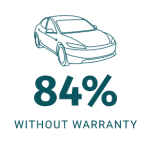
S&P Global projects that by the end of 2026, roughly 371 million vehicles in Europe
will be operating outside their warranty period. That represents approximately
84% of the total vehicle parc in the region.
What does this imply?
If these projections hold, the aftermarket will have access to a massive pool of vehicles requiring replacement parts, maintenance, repairs, diagnostic tools, and ongoing servicing.
Europe is also the world’s largest VIO (Vehicles in Operation) market and has the highest average number of light vehicles. The average vehicle age is expected to cross the 14-year mark in 2026 and climb to 16 years by 2034.
The key drivers behind this rising average age are:
- Increasing prices for new vehicles
- Uncertainty surrounding battery-electric vehicles (BEVs)
- Affordable maintenance costs as an alternative to replacement
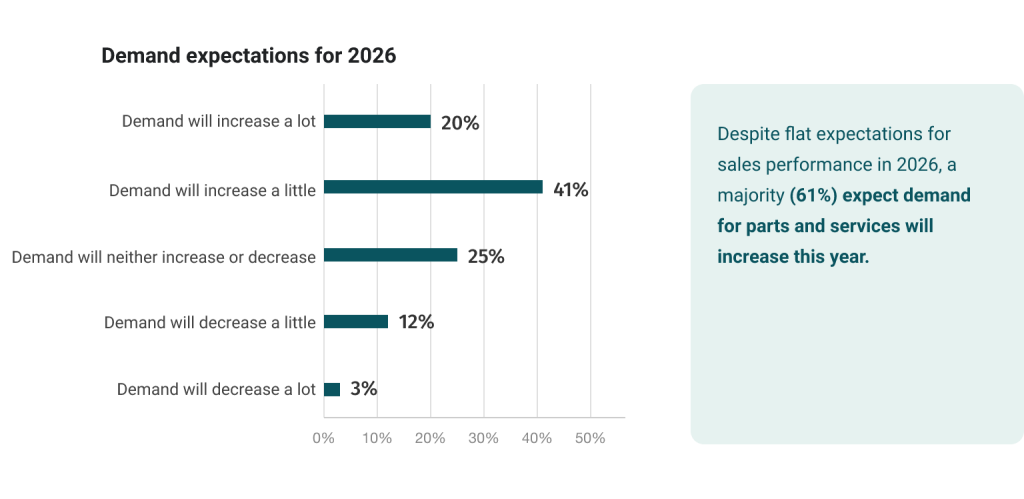
In North America, an AAPEX study found that 61% of respondents likewise expect demand for replacement parts and services to grow — despite the weaker economic environment.
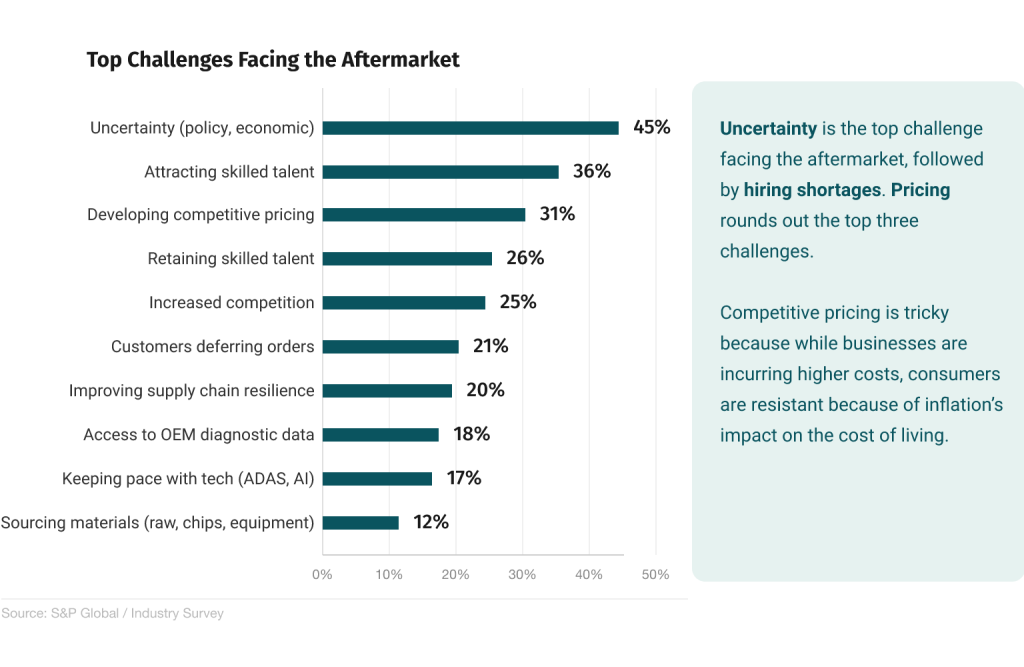
At the same time, respondents identify the biggest challenges for the aftermarket as the uncertainty caused by wars and crises (45%) and the difficulty of meeting customers’ expectations of low prices (31%). While companies themselves face rising costs, consumers are holding back across the board as inflation continues to squeeze household budgets.
Price remains the decisive purchase driver. In Western markets, price-related criteria carry up to 15% more weight in vehicle decisions than in Asian markets. Anyone selling parts and accessories in the aftermarket feels this pressure directly — because customer expectations of affordable vehicles carry over to replacement parts and services as well.
Beyond price sensitivity, several additional factors are reshaping the automotive aftermarket in fundamental ways.
Challenge 2: Electric Vehicles, Driver Assistance Systems and New Models Are Fundamentally Reshaping the Product Range
1. Electric Vehicles
Electromobility is no longer a future topic — it’s already the present, and it’s reshaping the aftermarket structurally. We sense this in every conversation with a customer, and the data clearly confirms it.
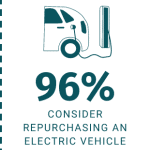
96% of current EV drivers intend to purchase an electric vehicle again with their
next car. EV penetration is advancing globally, though at uneven regional speeds.
In Asia, depending on the country, up to 85% of consumers are considering an electric
vehicle; in Europe, the range spans 46% to 79% depending on the market.
What does this mean for the aftermarket?
The traditional product range built around internal combustion engine (ICE) components will lose relevance over the medium term.
At the same time, entirely new parts categories are emerging:
- Battery management
- Charging technology
- Electric drivetrain components
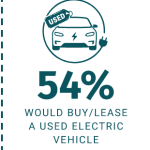
54% of consumers would buy or lease a used electric vehicle.
Of the 46% who would not, 65% cite concerns about battery life as the primary barrier,
and 34% point to a lack of warranty or service coverage.
For IAM players, this opens a clear structural advantage: those who can offer battery certifications, service guarantees, and reliable parts data for EV components will be positioned to win. In our experience, this is exactly where solid product data makes all the difference—not as a nice-to-have, but as a must-have.
2. Driver Assistance Systems

By the end of 2026, more than 132 million vehicles on European roads will be equipped with
some form of Advanced Driver Assistance System (ADAS). By 2035, over 82% of the vehicle
parc in Greater China, 69% in North America, and 62% in Europe will be ADAS-equipped.
This far-reaching integration of ADAS into vehicles will require aftermarket suppliers and workshops to adapt their service capabilities and business models to meet the demands of these advanced systems.
3. Growing Model Diversity
Model diversity is also expanding at an explosive pace. Chinese brands in particular — including BYD, NIO, and Chery — are steadily gaining international market share. Skepticism toward Chinese vehicles outside of China is slowly fading.
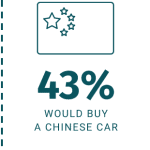
43% of consumers would now consider a Chinese brand, an increase of
4 percentage points over the previous year.
Challenge 3: Transparency and Trust as the New Competitive Parameters
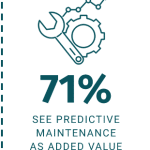
71% of consumers see real value in predictive maintenance — knowing when which
parts will be due before damage occurs. 64% prefer bundled, prepaid service packages.
Both expectations require aftermarket suppliers to deliver product information that
is precise, complete, and machine-readable.
At the same time, product information quality in the aftermarket is no longer a nice-to-have — it has become a purchase criterion.
Online platforms for vehicle parts are firmly established: end customers use them to compare parts prices, research specifications, and challenge workshops on their pricing.
Suppliers who deliver flawed or incomplete data lose orders and face returns and complaints.
The study also reveals that 82% of consumers still want to close the final purchase with a dealer. The human component remains indispensable. But the upstream phase — research, comparison, and configuration — happens entirely online. This is something we see confirmed time and again in our consulting work: Today, the customer journey begins in the browser, not in the repair shop.
Challenge 4: Growing Complexity of the Automotive Data Landscape
The aftermarket is wrestling with a challenge that grows with every new model and every new model year: the relationships between parts, engines, and vehicles are becoming increasingly complex.
A single product may be relevant for hundreds of vehicle variants — or none at all. Mistakes erode trust quickly and drive away future and repeat customers. Shipping the wrong part to a workshop leads, at best, to a return. At worst, it results in a serious safety defect.
On top of that come:
- Rising regulatory requirements across multiple markets
- Growing demands on digital catalog formats (TecDoc, ACES, PIES, Fraga)
- Mounting pressure to make data available faster and across more channels
The Answer: AutomotivePIM by Bertsch Innovation
AutomotivePIM addresses every one of the challenges outlined above. Purpose-built for the specific realities of the automotive aftermarket, this PIM and DAM solution serves as the central platform for managing, enriching, and publishing product and media data — exactly the way aftermarket players need it.
AutomotivePIM puts the complex relationships between replacement parts, engines, and vehicles at the center. A look at the numbers from a real-world customer system shows the scale the platform handles:
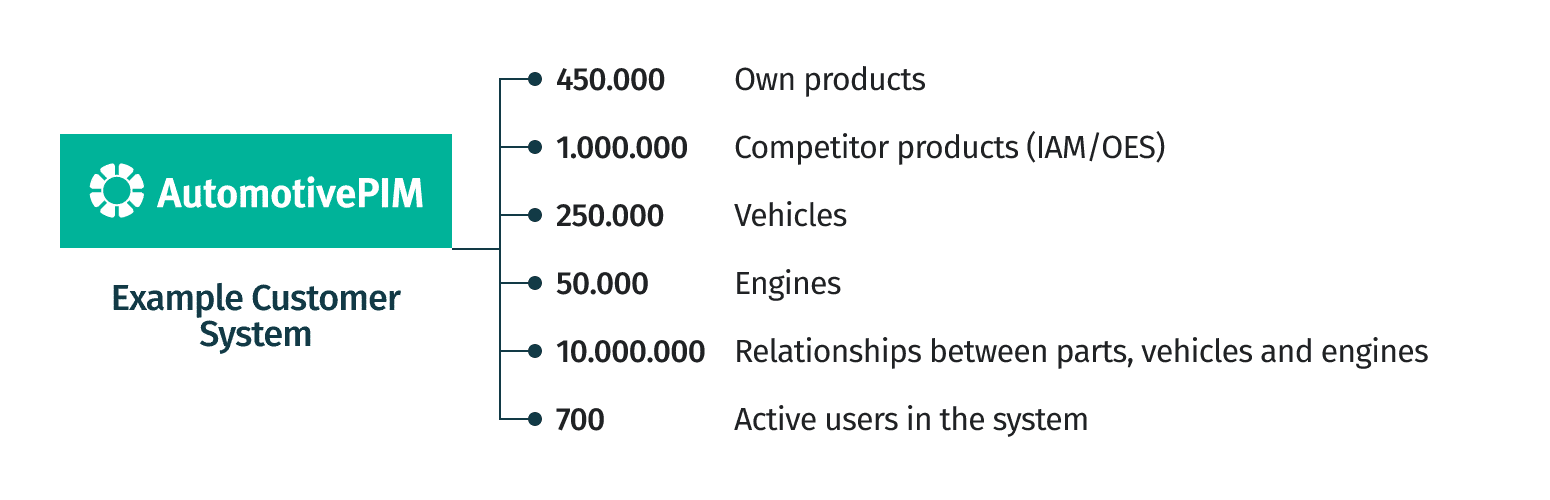
These figures make one thing clear: AutomotivePIM is engineered precisely for the level of complexity that defines the modern aftermarket.
Core Capabilities That Make the Difference
1. Complete Control Over Part-to-Vehicle Relationships
AutomotivePIM enables flexible, automated import and export as well as the assignment of replacement parts to engines and vehicles.
2. Native Support for Global Vehicle Data Formats
TecDoc, ACES, PIES, Fraga, and other formats are supported natively.
3. Range Expansion Built on a Solid Data Foundation
The push to sell more products to the same customer at higher margins is universal in the aftermarket.
This is the key factor we consistently emphasize in strategic discussions with clients: data as the foundation for sustainable competitive advantages.
4. Faster Time-to-Market
Collaboration between R&D, manufacturing, and sales is accelerated within AutomotivePIM through structured workflows and clear approval processes.
5. Omnichannel Publishing from a Single Source
Webshops, marketplaces, mobile apps, TecDoc, dealer portals, Web2Print and more. Every channel is supplied consistently from one curated data foundation.
6. AI-Powered Automation
Automated tagging, AI-driven data quality checks, and intelligent field mapping on import dramatically reduce manual effort.
Conclusion: Product Data as a Strategic Advantage
One thing is clear to us: the 2026 automotive market will reward suppliers who can deliver transparency, reliability, and consistency. Price-sensitive consumers, growing EV assortments, digital purchase decisions, and complex distribution landscapes turn precise, complete product data into a strategic advantage.
Aftermarket companies still running their product data processes on manual workflows or fragmented systems risk more than operational inefficiency — they risk losing relevance and falling behind the competition.
AutomotivePIM by Bertsch Innovation provides the technological foundation to meet this challenge head-on.
Want to see how AutomotivePIM works in your system landscape? Get in touch — we’ll show you AutomotivePIM live, tailored to your specific use case.
Sources:
– S&P Global: Automotive Aftermarekt Industry Trends
– “2026 State of the Automotive Aftermarket Survey Report” – AAPEX, 2026
– “Global Automotive Study 2025” – Simon-Kucher/ Q2 2025


Carl Brenninkmeijer

Sebastian Platz

Highlighted Whitepaper
ePaper: Automotive Aftermarket
Download onze automotive aftermarket e-paper en kom meer te weten over de dagelijkse uitdagingen van fabrikanten, werkplaatsen en serviceproviders.