Blog
How PIM Software Supports
ETIM and ECLASS Classification
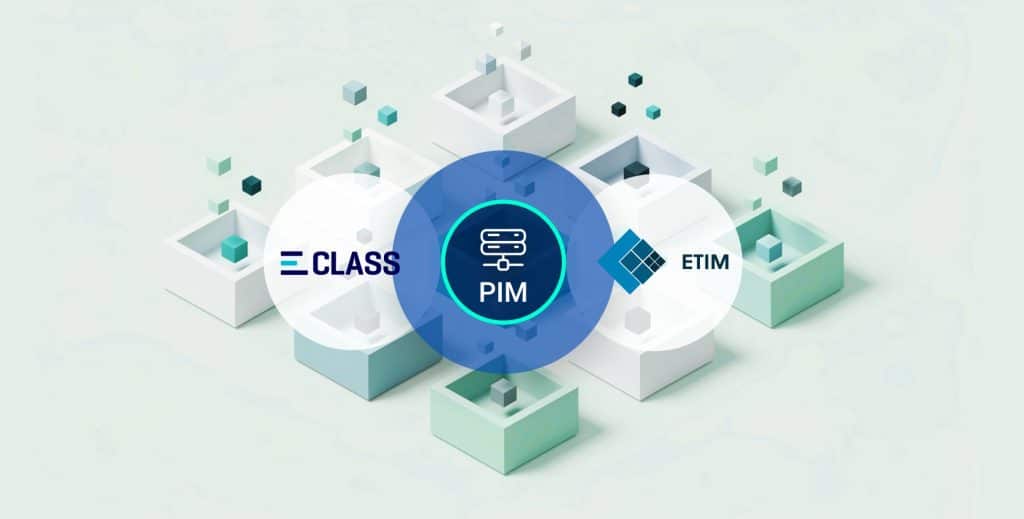
For B2B manufacturers and distributors, product data quality and structure have become a critical competitive differentiator. Managing products internally is no longer enough — customers, marketplaces, and distributors demand data in standardized formats to automate their own processes. This is where classification standards like ETIM and ECLASS come in.
Implementing and maintaining these standards, however, presents organizations with significant challenges. Without the right technological foundation, teams frequently find themselves buried in manual spreadsheet work and error-prone processes.
The right software changes that. mediacockpit — combining PIM, DAM, and state-of-the-art AI — has been the established solution for over 25 years, purpose-built to handle complex classification requirements with efficiency and precision.
What Are ETIM and ECLASS — and Why Are They Essential?
ETIM and ECLASS are established standards that serve as a shared language between manufacturers, distributors, and end users.
What Is ETIM?
ETIM is the classification standard purpose-built for the electrical and construction industries. The Electronic Technical Information Model (ETIM) is specifically designed to meet the requirements of electrical installation, plumbing, heating, and HVAC (PHVAC), as well as the building materials trade. Unlike ECLASS, which uses a deeply nested hierarchical structure, ETIM is flat by design — focusing on the technical attributes that matter most for sales and product selection in wholesale distribution.

Example: ETIM in Practice
Consider an LED light source classified under ETIM:
ETIM CLass: EC001959 (LED Lamp / Multi-LED)
Attributes:
- Rated voltage: 240 V
- Luminous flux: 806 lm
- Base: E27
- Color temperature: 2700 K
- Power consumption: 9 W
What is ECLASS?
ECLASS is a cross-industry product data standard — a globally adopted, hierarchical framework for classifying and uniquely describing products and services. It spans virtually every industry, from electrical engineering and mechanical engineering to medical technology. ECLASS enables seamless digital data exchange across the entire product lifecycle.

Example: ECLASS in Practice
Consider a hex bolt classified under ECLASS:
ECLASS Hierarchy: 23-11-01-01 (Fastener > Screw > Hex Bolt)
Attributes:
- Thread size (metric): M12
- Length: 50 mm
- Material: Steel
- Strength class: 8.8
Why Do Companies Need to Classify Products According to ETIM or ECLASS?
There are several compelling reasons why companies are increasingly required to classify their products according to one of these two standards:
- Market access: Many wholesalers and platforms only accept product data that is classified according to ETIM or ECLASS.
- Comparability: Customers can filter and compare products based on technical attributes — such as voltage, material, or diameter.
- Process automation: Standardized data enables automated import into ERP systems, online stores, and planning tools such as BIM.
- Error reduction: Clearly defined attributes reduce mis-orders and the returns that result from them.
The Challenges Companies Face: Product Data Chaos
Before companies can begin classifying their product data, the groundwork must be laid — and in many B2B organizations, the reality of product data management is defined by inconsistencies and data silos. In other words: chaos.
A rapidly growing volume of product information is fueling a full-scale product data explosion. More SKUs, more channels, and increasing regulatory requirements are colliding with processes that simply haven’t kept pace.

1. Fragmented Systems
Technical data lives in the ERP, images are scattered across Dropbox or agency servers,
and marketing copy sits in Excel spreadsheets. No system has visibility into the
others — a recipe for pervasive inconsistencies across the board.

2. Manual Work as a Productivity Killer
Employees spend hours on copy-paste tasks, manually reconciling version conflicts,
or painstakingly assigning ECLASS and ETIM attributes in spreadsheets. This isn’t
just costly — it’s a significant source of errors.

3. The Complexity Trap
Technical B2B products often involve deep hierarchies and complex variant logic.
Conventional e-commerce PIM systems quickly hit their limits here, as they are primarily
optimized for managing straightforward product catalogs. For industry-specific
classification, companies are typically forced to seek out a separate solution entirely.
The solution: mediacockpit PIM
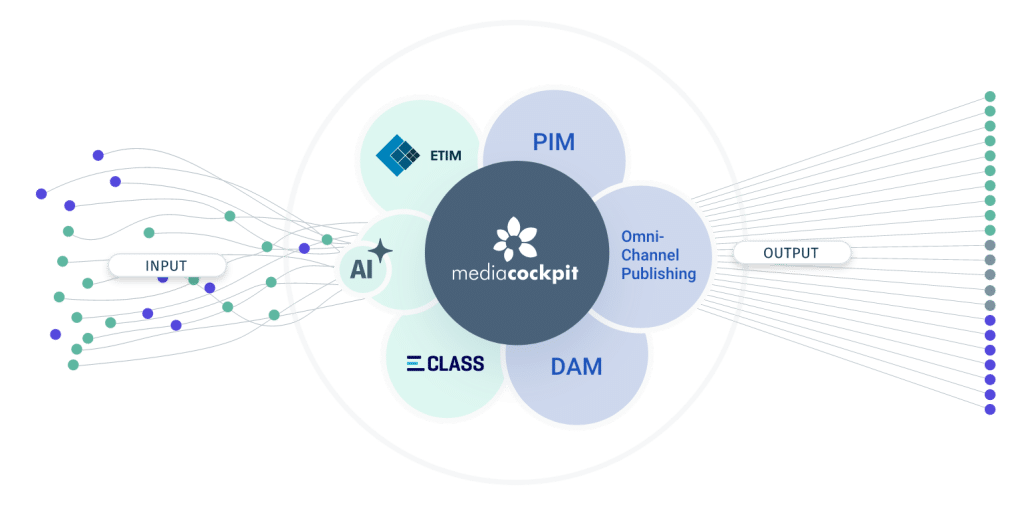
mediacockpit was purpose-built for organizations where complexity is the norm. As an integrated platform combining PIM (Product Information Management), DAM (Digital Asset Management) and omni-channel publishing, it is designed to handle large volumes of complex data — serving as the organization’s central data foundation or single source of truth.
Native Standards Support
One of mediacockpit’s key advantages is native support for classification standards including ETIM, ECLASS, and UNSPSC. These standards don’t need to be custom-built or bolted on — they are an integral part of the data model from the ground up.
Automation Through AI and e-proCAT
To ensure consistently efficient workflows, mediacockpit integrates modern AI capabilities directly into its platform architecture — delivering value to B2B organizations in several ways:
- AI-powered data onboarding: When importing Excel or CSV files, the AI automatically recognizes column structures and maps them to the correct attributes.
- Pre-classification: Machine learning models analyze product descriptions and suggest the appropriate ETIM or ECLASS classes — significantly reducing manual effort.
- e-proCAT integration: Through seamless connectivity with e-proCAT, classified data can be validated, maintained, and exported as electronic catalogs — including formats such as BMEcat.
Quality Management and Workflows
mediacockpit continuously monitors data quality across the entire product catalog. If a required field for an ETIM class is missing, the responsible product manager is proactively notified. Defined workflows ensure that only validated, fully classified data is published to downstream channels.
The Value of mediacockpit as a Complete Solution
Beyond classification alone, mediacockpit delivers significant advantages for B2B organizations through its holistic approach to product content management.
1. PIM + DAM in a Single Interface
In many organizations, product data and digital assets — images, CAD drawings, data sheets — are stored in separate, disconnected systems. mediacockpit brings these worlds together. Every image is directly linked to its product. When a technical attribute changes in the PIM, an updated data sheet can be generated automatically.
2. Efficiency Gains Through AI (Product Content Engine)
mediacockpit acts as a true content engine. AI assistants automatically generate compelling marketing copy from technical attributes and translate product descriptions into up to 47 languages — context-aware and at scale. This dramatically accelerates time-to-market.
3. Flexibility and Integration
Built on an API-first architecture with a fully documented enterprise REST API, mediacockpit integrates seamlessly into existing system landscapes — including ERP systems, Shopware, Magento, and Adobe Creative Cloud. It adapts to the organization’s architecture, not the other way around. This makes both data ingestion and channel-specific distribution of product data to all relevant touchpoints straightforward and scalable.
From Data Manager to Classification Expert to Content Strategist
For B2B manufacturers, accurate classification according to ETIM and ECLASS is often a non-negotiable requirement. With the right support, however, this complex task becomes far more manageable. Companies such as Stübbe and Bette — both satisfied mediacockpit users — demonstrate how the platform enables the shift from manual, error-prone processes to a fully automated single source of truth.
mediacockpit gives organizations more than just a data management tool. It is a platform that optimizes the entire content value chain — through built-in classification capabilities and the powerful combination of PIM, DAM, and AI.
The result: faster time-to-market, consistent brand presence across all channels, and a significant reduction in repetitive, resource-intensive work for your teams.
Have questions about implementing specific ETIM or ECLASS versions in your organization? We’d be happy to walk you through how mediacockpit can support your classification needs and integrate into your existing IT landscape.

Highlighted Whitepaper
ePaper: Strategic Product Content Management with PIM & DAM
Hoe je je product content management duurzaam kunt optimaliseren: in onze whitepaper laten we je zien hoe je je processen kunt optimaliseren met een PIM & DAM – inclusief waardevolle inzichten en beproefde strategieën.
Samen meer bereiken
Wij geloven in de waarde van samenwerking en uitwisseling. Dit geldt zowel de projecten met onze klanten, waaruit we veel waardevolle inzichten genereren voor onze productontwikkeling, als voor ons groeiende partnernetwerk, waarmee we onze klanten ondersteunen bij hun digitalisering.