Blog
Managing Increasing Product Complexity in B2B:
How Organizations Maintain Control Over Product Data

Many organizations believe their product complexity is temporary. Something they are passing through while they grow, expand into new markets, or launch new product lines. Once things stabilize, they expect complexity to settle down as well.
In reality, that moment rarely comes. Across manufacturing, automotive, and complex B2B environments that complexity does not disappear. It accumulates. What once felt manageable gradually becomes structural. And the assumptions that worked in earlier stages no longer hold.
Definition: Extreme Product Complexity
Product complexity is not a temporary phase but a structural condition.
Extreme product complexity refers to the accumulation of new products, additional variants, dependencies, regulatory requirements, and organizational silos that reinforce each other over time.
The Root Causes of Complexity: Scale, Variants, and Dependencies
Product complexity often grows quietly:
A few more SKUs.
Additional variants.
Another market.
A new language.
An extra channel.
A regulatory requirement layered on top of what already exists.
Individually, none of these changes feel disruptive. Together, they fundamentally change the nature of the organization’s product landscape. What was once a simple catalog becomes a network of interdependencies: products linked to variants, standards, markets, and channels, all maintained by multiple teams with overlapping responsibilities.
At that point, complexity is no longer an exception. It is the operating reality.
Organizational Structures, Silos, and Regulations: How Complexity Truly Escalates
Extreme product complexity is not defined by a single factor.
It is not simply a matter of having many SKUs, nor is it only about managing variants or technical hierarchies. Complexity emerges when scale and structure begin to reinforce each other.
As assortments grow, products are no longer standalone items but parts of multi-level hierarchies. Variants and compatibility rules introduce dependencies that must remain consistent across the entire portfolio.
Organizations expand into multiple markets, each with different languages, requirements, and expectations.
Industry standards and regulatory frameworks add another layer, turning product information into something that must be accurate, auditable, and compliant.
What intensifies this complexity even further is the way organizations are structured internally. Teams operate in silos. Marketing, product management, channel management, operations, and IT all contribute to the same product data, but not always in alignment. Without a single source of truth, data consistency breaks down, responsibilities blur, and walls form between departments. These problems compound when information crosses organizational boundaries – every handoff without a unified system becomes another source of inconsistency, delay, and error.
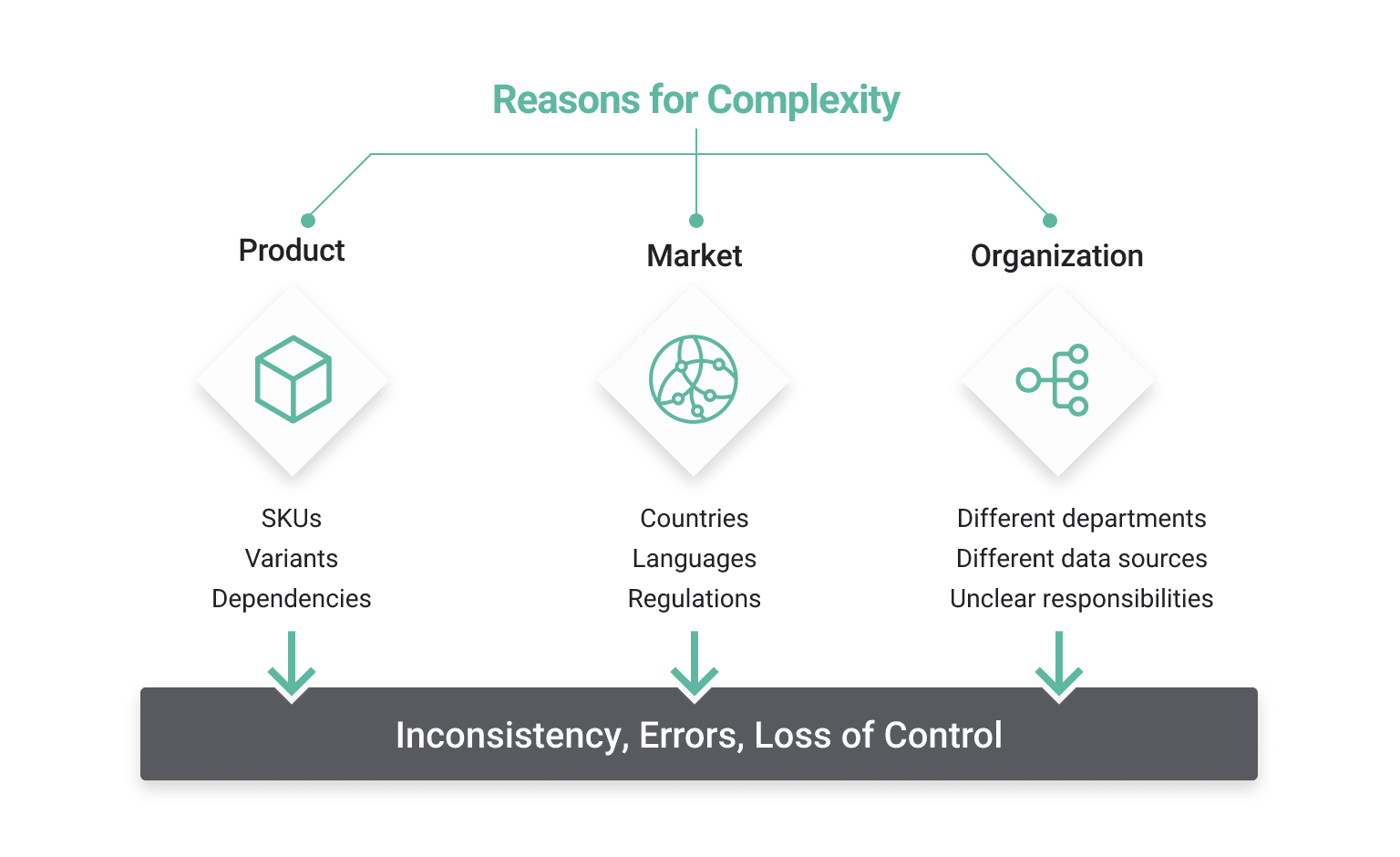
As interdependencies grow, so does the risk of inconsistency, error, and loss of control. What once felt manageable becomes fragile.
This is why complexity in B2B and automotive environments is fundamentally different from complexity in pure e-commerce contexts. It is technical by nature, shaped by standards and regulation, and operationally critical to the business.
Why lightweight solutions start to break down
Lightweight systems often work well at first. They are easy to implement, intuitive to use, and deliver quick results. For organizations in earlier stages, they can be entirely sufficient.
The problems arise when complexity grows beyond what these systems were designed to handle.
A common illusion at this stage is what many teams refer to internally as the “Excel promise”: the belief that complexity can still be managed manually, just with better spreadsheets, more rules, or more discipline. In reality, this approach rarely reduces complexity. It shifts it.
Download: Comparing PIM, ERP and Excel
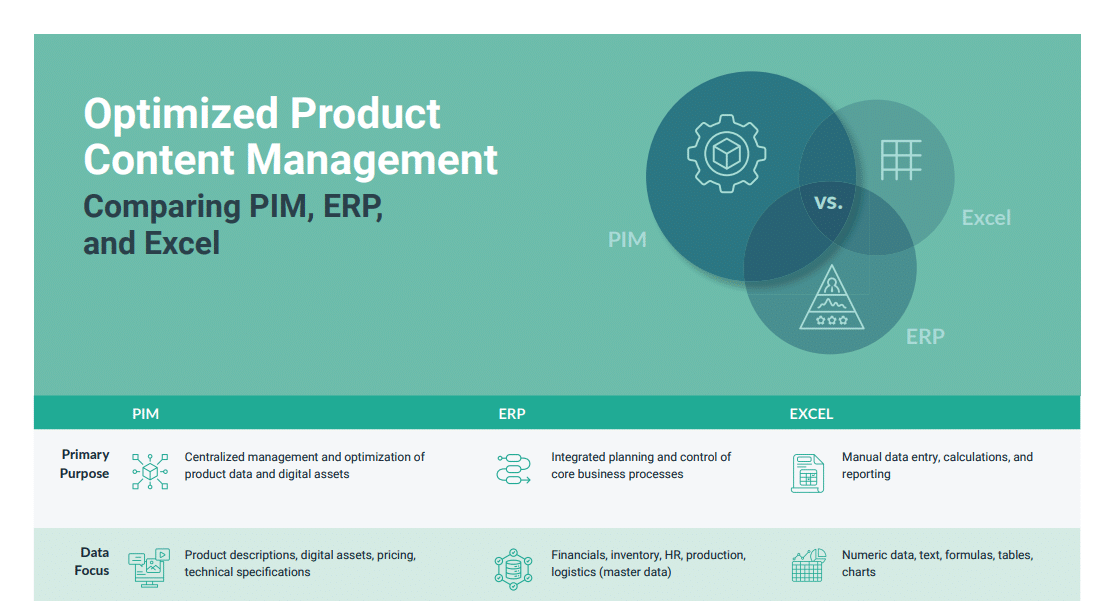
The first signs are subtle. Exceptions become more frequent. Manual checks are introduced to compensate. Additional spreadsheets appear to bridge gaps. Over time, teams adapt their processes around the system instead of the system supporting the process.
What often happens next is not simplification, but expansion of workload. More manual effort requires more people. Headcount grows not because the business scales, but because complexity must be maintained by hand. Work becomes more repetitive, more error-prone, and less rewarding. Productivity stagnates, while pressure on teams increases.
How This Structural Challenge Can Be Addressed: PIM Software
At this stage, the issue is often misunderstood as a tooling problem. In reality, it is a structural one.
Extreme complexity changes what an organization needs from its foundation. It demands consistency across scale, clarity across teams, and control across markets and channels. Without that foundation, complexity turns from a manageable condition into a source of continuous risk.
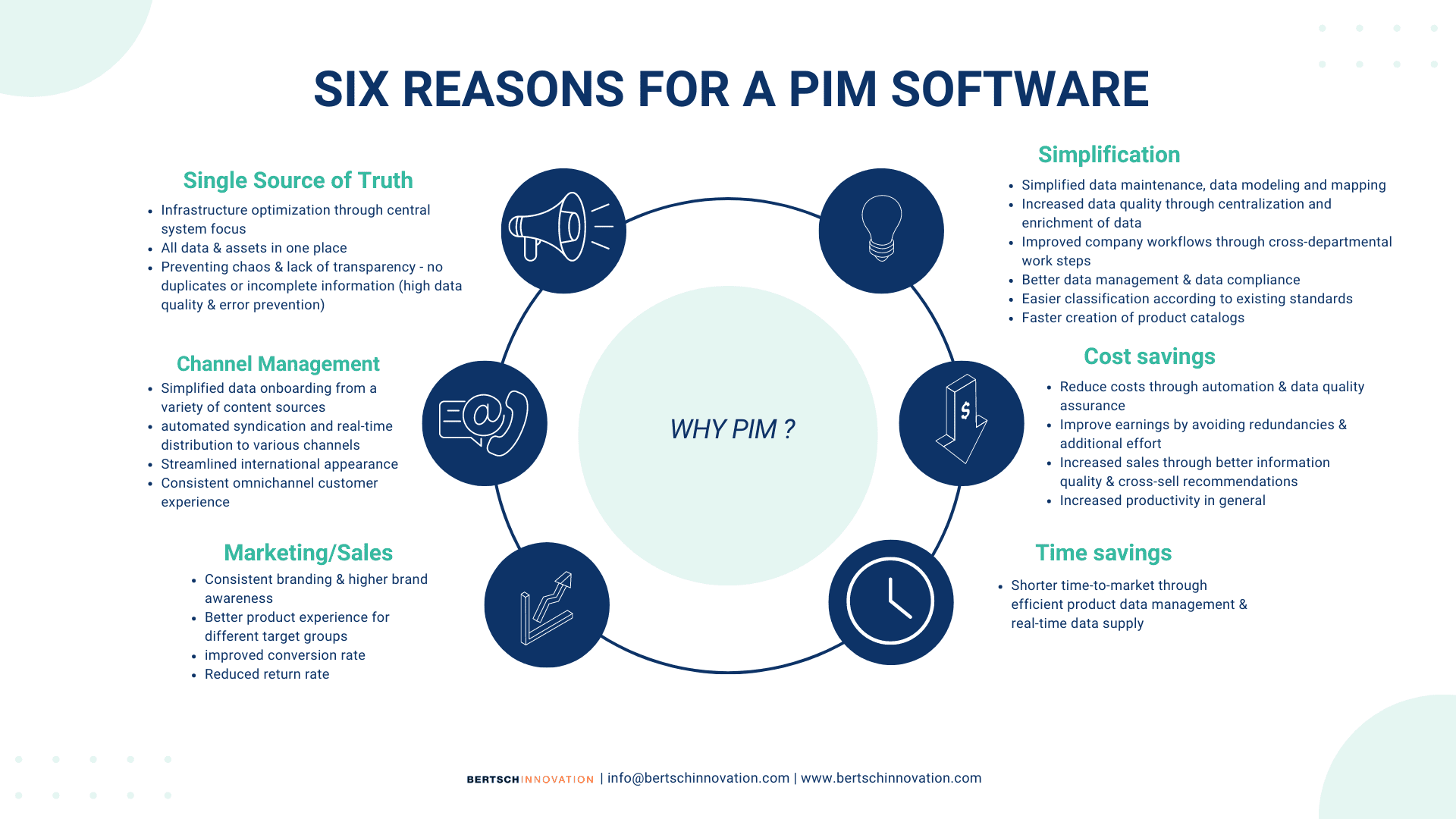
This is not about finding a quick fix. It is about recognizing that the operating environment has fundamentally changed. To manage this complex situation and regain control over expanding product data management, companies need not only a shift in mindset but also software designed specifically for this purpose. This is where dedicated PIM systems come into play. They provide the foundation organizations need to master the complexity of product data management.
Download: reasons for a PIM software
Why Complexity Management Is a Leadership Responsibility
The most important shift is recognizing that extreme complexity is not a phase to move through, but a condition to manage deliberately.
Organizations that accept this reality make different choices: They stop optimizing for short-term convenience and start designing for long-term control. Firefighting gives way to structured ownership, and teams are enabled to manage complexity intentionally rather than reactively.
A suitable PIM solution supports companies in this effort.
When silos are reduced and teams work together on a single, shared foundation, the return is not only financial. Efficiency improves, workload becomes manageable, and work regains meaning. People spend less time correcting errors and more time creating value.
Because complexity itself is not the enemy. Loss of control is.

Highlighted Whitepaper
ePaper: Strategic Product Content Management with PIM & DAM
Comment optimiser la gestion du contenu produit pour un succès à long terme : Découvrez comment rationaliser vos flux de travail avec PIM et DAM. Notre livre blanc offre des informations pratiques et des stratégies éprouvées pour vous aider à mettre en place une approche évolutive, efficace et pérenne de la gestion du contenu produit.
Accomplir plus ensemble
Nous croyons en la valeur de la collaboration et de l’échange. Cela s’applique aussi bien à nos projets clients, desquels nous tirons de nombreuses informations précieuses pour le développement de nos produits, et à notre réseau de partenaires en pleine expansion, avec lequel nous soutenons nos clients dans leur numérisation.