Blog
The Digital Product Passport:
Industries, Requirements and Deadlines at a Glance
Why Companies Should Start Building the Right Data Foundation Now

The Digital Product Passport (DPP) will fundamentally reshape European industry in the years ahead. It is much more than another compliance requirement: it is one of the most important drivers of transparency, the circular economy and digital competitiveness in Europe.
For companies, the question is no longer whether they need to address the DPP, but how quickly they can prepare.
What Is the Digital Product Passport?
The Digital Product Passport is a digital information container that brings together relevant product data throughout a product’s entire lifecycle and makes it accessible to the appropriate stakeholders. These are manufacturers, distributors, service technicians, recycling companies and public authorities.

Depending on the product category, this information may include:
The data itself is not stored in the DPP. Instead, it remains decentralized with the responsible companies or DPP service providers. A data carrier, such as a QR code, simply provides access to the relevant information.
The Legal Framework
The legal basis for the DPP is the European Ecodesign for Sustainable Products Regulation (ESPR), which has applied as the EU Ecodesign Regulation since July 18, 2024. It establishes a harmonized European framework designed to make products more durable, repairable, and resource-efficient.
The ESPR replaces the previous Ecodesign Directive, which was limited to energy-related products, and will eventually cover nearly all physical products placed on the EU market.
Exceptions include food, animal feed, medicinal products, and certain vehicles.
A Phased Rollout: Why Waiting Is Not an Option
The DPP will not become mandatory for every product at the same time. The rollout begins with batteries: starting February 18, 2027, a battery passport will be mandatory for certain industrial, vehicle, and traction batteries.
Additional product categories will follow through product-specific delegated acts.
Which Industries Will Be Most Affected?
According to the ESPR Working Plan 2025–2030, priority areas include iron and steel, aluminum, textiles, tires, furniture, mattresses, detergents, paints, lubricants, chemicals, energy-related products, and ICT products.
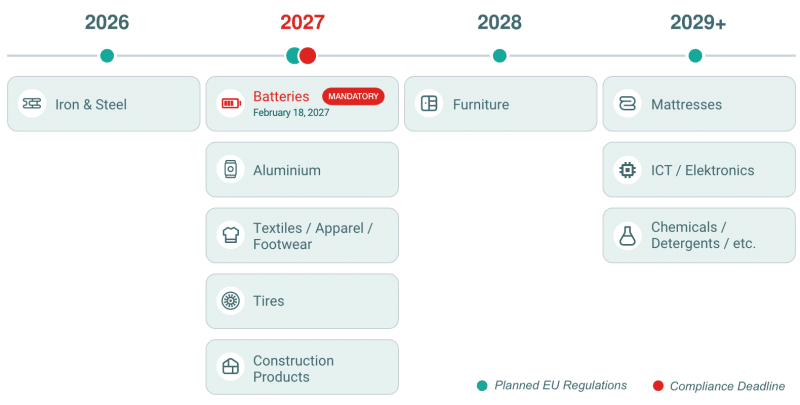
The first specific delegated act is expected to cover iron and steel products. Once the relevant requirements have been published, companies will generally have at least 18 months to implement them.
| Industry / Product Group | Relevance | Current Timeline for EU Rules* | Why It Matters |
|---|---|---|---|
| Batteries / Automotive / E-Mobility | very high | Mandatory February 18, 2027 for certain batteries | Origin, material composition, battery parameters, recycling/second life, etc. |
| Iron & Steel | very high | 2026 | Carbon/environmental data, material origin, recyclability; important across industrial supply chains |
| Aluminum | very high | 2027 | Material and sustainability data, circularity |
| Textiles / Apparel / Footwear | very high | 2027 | Materials, origin, repairability, recycling, and circular economy |
| Tires | high | 2027 | Material, environmental, and circularity data |
| Furniture | high | 2028 | Materials, components, repair/reuse, and recycling |
| ICT/Electronics | high | From 2029 or product-specific | Repairability, components, spare parts, recycling, and recycled content |
| Construction Products | high | Separate regulatory framework; additional DPP rules planned from 2027 | Material, performance, environmental, and product information |
| Chemicals / Detergents | medium to high | Separate and/or additional regulatory frameworks | Composition, safety, environmental, and circularity information |
*The dates from 2026 to 2029 primarily refer to the planned adoption of product-specific rules, not necessarily the date on which every corresponding product must have a DPP. The applicable delegated act will determine the specific transition and compliance deadline. The European Commission currently lists iron and steel for 2026; textiles, tires, and aluminum for 2027; furniture for 2028; and mattresses and ICT for 2029.
What Does This Mean in Practice?
As noted above, the specific legal obligations will not apply to every industry at the same time. However, companies should start building a reliable data foundation today, regardless of their individual deadline. The necessary data structures cannot be created overnight.
A Closer Look at Industry Relevance
Why Is the DPP So Relevant to These Industries?
The DPP connects a unique product identifier with structured product information. The underlying data must be based on open standards and made available in an interoperable, machine-readable format.
This means manufacturers are not the only companies affected. Importers, distributors, suppliers, repair businesses, refurbishers, and recyclers will also become part of the data ecosystem. Different stakeholders may receive different access rights.
For companies in the affected industries, the DPP creates requirements in four key areas:
- Obtaining product data
- Consolidating data from across the supply chain
- Ensuring data quality and verifiability
- Making product data available in a technically interoperable format
At the same time, the DPP creates opportunities in areas such as traceability, repair and refurbishment services, recycling, after-sales services, and new data-driven business models.
The European Commission explicitly identifies transparency, traceability, and improved interoperability of product data as key benefits.
A Closer Look at Individual Industries
The DPP will become mandatory for different industries at different times. The following examples illustrate what this means for several key sectors.
1. Batteries / Automotive / E-Mobility
When Does the Requirement Take Effect?
This is where the regulatory situation is currently clearest. Starting February 18, 2027, every newly placed on the market or put into service electric vehicle battery, LMT battery (Light Means of Transport, such as e-bike and e-scooter batteries), and industrial battery with a capacity greater than 2 kWh must have an electronic battery passport.
This is therefore a firm statutory deadline.
For the automotive sector, an important distinction needs to be made: the requirement does not mean that every complete vehicle must have a DPP as of February 18, 2027. Rather, the requirement applies in particular to the relevant traction battery.
Why Is a DPP Particularly Relevant for Batteries?
Batteries are especially significant from a regulatory perspective because material origin, production, use, and end-of-life are closely interconnected.
The EU aims to make it possible to trace:
The battery passport therefore contains both model-level information and data specific to an individual battery. This includes information about composition, components, disassembly, performance, service life, state of health, and status classifications such as “original,” “re-used,” “repurposed,” or “remanufactured.”
Typical Data Challenges
This is where the DPP quickly becomes a data integration challenge:
Companies also have to deal with changing suppliers and a wide range of data formats.
Another challenge is that not all information is static. Some passport data is generated during production, while other information changes throughout the lifecycle of the individual battery.
This requires a reliable connection between the product ID, serial number, components, and subsequent lifecycle data.
Why Start Building the Data Foundation Now?
Because there is effectively very little preparation time left. The February 18, 2027 deadline is only a few months away, and the EU DPP registry has already been operational since July 2026, allowing companies to begin testing technical integration and registration.
The real project is not printing a QR code on a battery. The challenge lies in obtaining and providing all the relevant data.
Companies that cannot reliably establish these connections today face a concrete compliance risk in 2027.
2. Tires
When Does the Requirement Take Effect?
Tires are also among the ESPR priority groups for 2027. The European Commission’s current roadmap calls for the product-specific delegated act to be adopted in Q3–Q4 2027. The actual mandatory compliance date will be defined in that act. A transition period of at least 18 months is expected to follow.
In other words, 2027 is currently expected to be the year in which the specific regulatory framework is adopted.
Why Tires?
Tires consist of complex material mixtures, including natural and synthetic rubber, steel, textiles, carbon black/silica, additives, and more. At the same time, service life, wear, resource consumption, and end-of-life treatment are highly relevant.
A circular economy requires information about which materials a tire contains, how it was manufactured, what characteristics it has, and what can be done with it at the end of its useful life.
Product identity is particularly important for retreading, recycling, and material recovery.
Typical Data Challenges
Tire formulations are often highly complex and may contain business-critical information. Material data comes from numerous upstream processes and suppliers. Production batches, compounds, and individual tires need to be connected.
This creates a common tension between traceability and the protection of trade secrets.
For this reason, the DPP concept provides for different access rights for different stakeholders. Not every piece of information stored in a DPP must automatically be publicly accessible to consumers. The ESPR requires product-specific rules to define which information is available, at what level of granularity, and to which stakeholders.
Why Start Building the Data Foundation Now?
Companies first need to determine whether their material, supplier, batch, environmental, and product data can actually be linked.For tire manufacturers in particular, the challenge can span multiple levels:
Raw material → compound → production batch → tire model → individual tire → use → end-of-life
Building a reliable data architecture for this chain can take considerably longer than implementing the DPP technology itself.
3. ICT / Electronics
When Does the Requirement Take Effect?
Information and communications technology (ICT) products are also among the ESPR priorities, although they are scheduled somewhat later.
The current working plan identifies 2029 as the target year for developing or adopting product-specific requirements for ICT products. Work on “energy-related products” is taking place in parallel between 2026 and 2029, meaning individual electronics products may also be affected through existing or updated Ecodesign requirements.
Why Is ICT Particularly Relevant to the DPP?
Electronics are practically a textbook example of what the DPP is designed to address: complex bills of materials, numerous suppliers, critical raw materials, spare parts, software, repairability, and recycling.
A DPP could, for example, provide information on materials and components, hazardous substances, repairability, spare parts, maintenance, environmental impact, recycling, and disassembly.
The European Commission explicitly identifies these types of information as typical potential content for future DPPs.
Typical Data Challenges
An electronic product can contain hundreds or thousands of components. This complexity makes product data management particularly challenging.
A typical supply chain might look like this:
OEM
→ Tier 1 supplier
→ Module manufacturer
→ Component manufacturer
→ Semiconductor manufacturer
→ Raw material supplier
As a result, the manufacturer of the final product often does not possess all the information that may become relevant for regulatory purposes.
Different versions of bills of materials, product variants, hardware revisions, and replacement components add another layer of complexity.
The key question will therefore not simply be, “Do we have the data?” but rather:
“Can we prove which data applies to the exact product variant that was sold?”
Why Start Building the Data Foundation Now?
ICT demonstrates why a seemingly long lead time can be misleading. Data needs to be collected across multiple supplier tiers.If companies wait until 2029, when specific DPP data points may be defined, only to discover that Tier 2 or Tier 3 suppliers cannot provide the necessary information, the problem cannot be solved overnight.
Companies should therefore standardize supplier requirements, bill-of-material structures, material declarations, and product identities now.
In many cases, the most important lever is not the DPP system itself, but effective Supplier Data Management and Master Data Management.
4. Construction Products
When Does the Requirement Take Effect?
Construction products are governed by a separate regulatory framework: the new Construction Products Regulation (EU) 2024/3110 — CPR. It explicitly provides for a Digital Product Passport system for construction products.
The European Commission currently plans to adopt the necessary delegated act in Q2 2027.
Importantly, the CPR already defines the mechanism in concrete terms: 18 months after the delegated act establishing the Construction DPP system enters into force, manufacturers must provide the corresponding product passports. The system itself is expected to become operational six months after that act.
If the currently planned act is adopted on schedule in 2027, the actual mandatory requirement would therefore likely fall around 2028/2029.
Why Construction Products?
Buildings have lifecycles spanning decades. For renovation, deconstruction, reuse or recycling, stakeholders may need to determine many years later which specific product was installed and what properties and materials it contains.
The Construction DPP is expected to include items such as the declaration of performance and conformity, general product information, instructions for use, safety information, technical documentation, labeling, and unique identifiers. It is also intended to be interoperable with Building Information Modeling (BIM).
The CPR even requires that the DPP system generally be capable of remaining accessible for up to 25 years after the relevant product type was last placed on the market.
Typical Data Challenges
Construction products often bring together entirely different information environments:
Much of this information is currently stored in PDF files rather than as structured data. Product variants, standards and declarations of performance can also change over many years.
A PDF archive is therefore not a sufficient DPP data architecture.
Why Start Working on the Data Now?
The challenge is to transform documents into structured data that can be clearly assigned to a specific product type.
A construction product manufacturer should already be able to establish relationships such as:
Product ID → Variant → Technical properties → DoP/compliance → Environmental information → Document version → BIM identifier
Companies that build these relationships now will be able to map future DPP data fields relatively quickly. Those that wait until 2028, on the other hand, may first have to clean up their entire document and product data landscape.
What Are the Consequences of Non-Compliance?
The DPP is not a voluntary recommendation. It is part of directly applicable European legislation. Based on the current regulatory framework, violations of the ESPR may result in fines, sales bans, recalls, and significant reputational damage.
This creates several very concrete risks for companies:

Loss of market access: Without a compliant Digital Product Passport, affected products may no longer be marketed in the EU. For affected companies, this could mean losing access to the European market for those products.

Stricter market surveillance: The DPP gives authorities access to structured, easily verifiable product data. This can make inspections simpler, faster and more effective, while making data gaps immediately visible.

Exclusion from supply chains: Large retailers and OEMs are likely to increasingly make DPP compliance a prerequisite for listing supplier products. Companies that cannot provide reliable data risk losing their position in the supply chain — regardless of whether their own products are already directly subject to a legal DPP requirement.

Competitive disadvantage: Competitors that provide transparent, high-quality product data early can actively differentiate themselves in the market, while late adopters risk falling behind with both customers and business partners.

Reputational damage: Recalls or publicly disclosed compliance violations can directly affect brand perception and customer trust. This is particularly serious in industries such as construction or chemicals, where safety and sustainability are core value propositions.
The implications are clear: the DPP is no longer simply a sustainability issue. It represents a tangible business risk with direct implications for revenue, supply capability and market access.
The Real Challenge: Building a Reliable Data Foundation
The most difficult technical aspect of the Digital Product Passport is not the QR code or the technology used to provide access to the information.
What matters most is the quality, completeness and accuracy of the underlying product data.
In many companies, product-related information is currently distributed across multiple systems, including ERP, PLM, CAD, document management platforms and Excel spreadsheets. Sustainability, material, and service data may also reside exclusively with suppliers or external partners.
For the DPP, all of this distributed information must be structured, consolidated, maintained, and kept continuously up to date.
Without this data foundation, even the most sophisticated DPP technology cannot deliver meaningful value.
Ultimately, a product passport is only as good as the data it contains.

Companies should therefore begin now by analyzing their existing product data, identifying data gaps, establishing data quality processes, harmonizing their system landscape and creating a centralized data platform — regardless of when their particular industry becomes subject to mandatory DPP requirements.
From Compliance Requirement to Strategic Business Advantage
Companies that view the Digital Product Passport exclusively as a regulatory obligation are overlooking much of its potential.
Structured, high-quality product data can also enable more efficient supply chain collaboration, faster time to market, streamlined service and maintenance processes, improved spare parts availability, new digital after-sales services, and greater transparency for customers.
The DPP is therefore evolving from a pure compliance instrument into a central component of a company’s digital product strategy.
This is precisely where the value of a modern Product Information Management (PIM) system becomes clear:
The DPP is the result of professional product data management and not its starting point.
mediacockpit: Building the Data Foundation for the Digital Product Passport
With mediacockpit, Bertsch Innovation provides the platform companies need to address this challenge.
As an integrated PIM and Digital Asset Management (DAM) solution, mediacockpit
- consolidates product data from ERP, PLM, CAD and other source systems in a central location
- structures it according to established classification standards
- makes it available across channel
From technical data sheets and spare parts information to sustainability metrics.
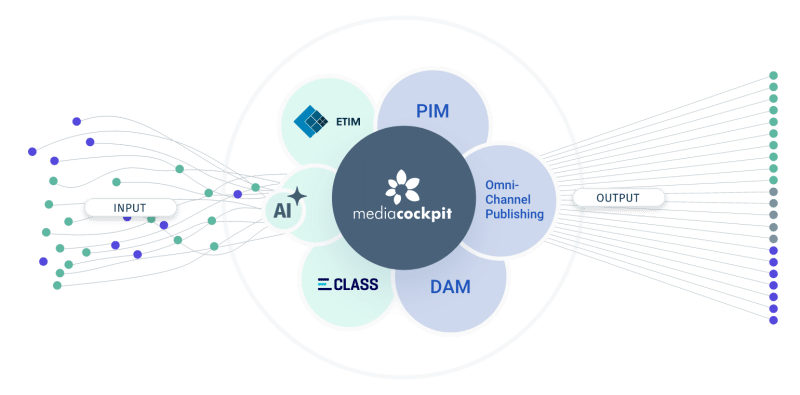
For the Digital Product Passport, this has a very practical implication: companies that begin consolidating their product data in mediacockpit today, systematically closing data gaps and establishing quality processes, are creating exactly the foundation required for a smooth DPP implementation.
And this applies regardless of whether a company’s product category becomes subject to mandatory requirements in 2027 or several years later.
Instead of scrambling to comply shortly before an 18-month implementation period expires, companies can approach the DPP from the outset for what it truly is: a strategic opportunity built on a solid, centrally managed product data foundation.
Conclusion
The Digital Product Passport will fundamentally change the rules for many industries.
Companies that invest now in a clean, centralized product data foundation will not only strengthen their regulatory readiness but also gain a genuine competitive advantage in an economy increasingly driven by transparency.
Sources:
- https://eur-lex.europa.eu/eli/reg/2024/1781/oj/eng
- https://single-market-economy.ec.europa.eu/single-market/digital-product-passport_en
- https://eur-lex.europa.eu/eli/reg/2024/3110/oj/
- https://single-market-economy.ec.europa.eu/news/digital-product-passport-registry-now-live-2026-07-20_en
- https://kpmg.com/de/de/themen/daten-und-technologie/digitaler-produktpass.html
- https://www.bitkom.org/sites/main/files/2026-03/bitkom-statusbericht-digitaler-produktpass.pdf

Highlighted Whitepaper
ePaper: Strategic Product Content Management with PIM & DAM
Comment optimiser la gestion du contenu produit pour un succès à long terme : Découvrez comment rationaliser vos flux de travail avec PIM et DAM. Notre livre blanc offre des informations pratiques et des stratégies éprouvées pour vous aider à mettre en place une approche évolutive, efficace et pérenne de la gestion du contenu produit.
Accomplir plus ensemble
Nous croyons en la valeur de la collaboration et de l’échange. Cela s’applique aussi bien à nos projets clients, desquels nous tirons de nombreuses informations précieuses pour le développement de nos produits, et à notre réseau de partenaires en pleine expansion, avec lequel nous soutenons nos clients dans leur numérisation.