Blog
Product Data as Business Risk:
Why Electrical Equipment Manufacturers Need to Act Now

Delisting by a distributor because of incomplete ETIM data. Certificates that expire unnoticed. The Digital Product Passport, which is being phased in as a mandatory requirement from 2027 and for which the data foundation is still missing today. What was once an internal filing problem has become a concrete revenue risk for electrical equipment manufacturers.
More SKUs, more classification versions, and ever-increasing compliance obligations. All of this in a market defined by a three-tier distribution chain in which the manufacturer often has no direct relationship with the end customer.
Companies that neglect their product data in this environment don’t just lose efficiency. They lose listings, visibility, and ultimately market share — and with it, revenue.
In this article, we examine the three forces that are simultaneously bearing down on electrical equipment manufacturers. We explain why the classic Excel-and-file-server approach is structurally ill-equipped to handle them, and how a combined PIM/DAM solution concretely helps organizations meet these challenges.
Three Forces Acting on the Electrical Engineering Industry
In conversations with electrical equipment manufacturers, you keep encountering the same starting point: product data sits in the ERP, images on a server, data sheets in SharePoint, and certificates scattered across various drives. As long as nothing changes, it all seems manageable. But the moment a distributor requests updated data or a product family needs to be revised, the manual searching begins — and that’s where the real problem starts.
What amplifies this structural problem is the simultaneity of three developments, each of which already creates pressure on its own. In combination, they can become truly critical.
1. Data Silos as the Default State
Technical data is created in the ERP, engineering data in CAD tools, images and copy in marketing, and certificates arrive from testing bodies via email. In many companies, no system knows what the others contain.
The result: when a distributor requests data, an internal project kicks off.
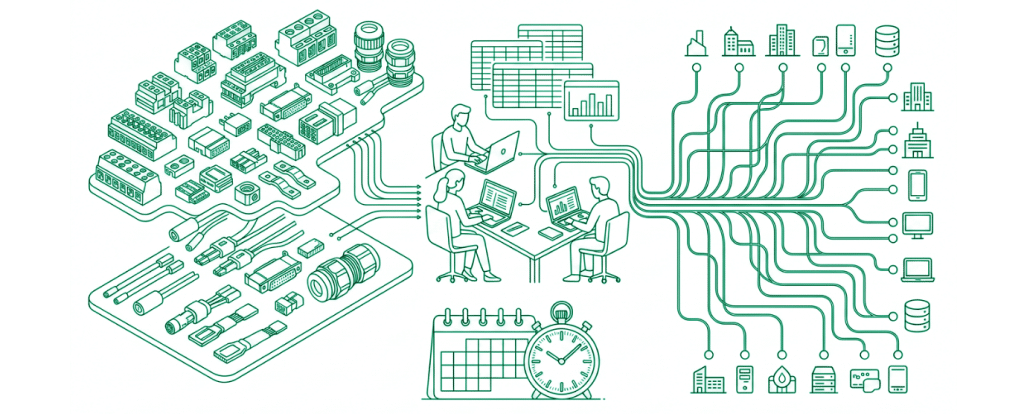
Every change to a product attribute must be manually replicated across multiple systems. This leads to substantial version chaos as an unavoidable side effect.
« We have over 30,000 articles in our product range. Previously, three employees maintained our data in Excel spreadsheets for around 20 distributors in 12 languages. Every new ETIM release was a week-long exercise. »
— Head of Product Data Management, manufacturer of terminal and connector technology —
2. Classification as the Entry Ticket
In the electrical engineering sector, ETIM is no longer an optional add-on. It’s the prerequisite for being listed in the wholesale catalog in the first place. The German electrical wholesale market is highly concentrated: market leader Sonepar Deutschland and the major mid-market groups DEHA and MITEGRO together account for more than half of the German market. Manufacturers who fail to deliver ETIM-compliant data in the right format simply won’t make it into their online stores and catalogs.
Complicating matters further, the classification landscape is anything but stable. ETIM 10.0, with 5,640 classes and 17,377 features, is the current standard. Since Q2/2026, ETIM xChange 2.0 — a modern JSON-based format — has been progressively replacing BMEcat as the exchange format. At the same time, different distributors still require different ETIM versions because they are migrating at different speeds.
For manufacturers, this means: maintaining multiple versions in parallel, plus ECLASS for industrial customers and, where applicable, UNSPSC for global marketplaces.
“Data quality is not simply an IT issue — it is a direct, revenue-critical factor.”
 Sebastian Hummel, Solution Consultant, Bertsch Innovation
 3. Increasing Compliance Requirements
While manufacturers are wrestling with classification pressure, a compliance wave is rolling in at the same time. CE marking, ATEX approvals, RoHS, REACH, WEEE — these requirements are not new for most electrical equipment manufacturers. But the way they are managed remains alarmingly unstructured in many companies:
The issue goes beyond internal effort. An expired certificate can trigger the delisting of an entire product family from a distributor’s catalog. And with the Digital Product Passport — mandatory from 2027 initially for batteries and from 2028 for further electrical products — structured requirements are coming that simply cannot be met with existing practices.

Regulatory Timeline Overview
EU Cyber Resilience Act: Reporting obligations under the CRA apply from September 2026 (fines up to €15 million or 2.5% of annual revenue).
Digital Product Passport for specific batteries: Mandatory from February 18, 2027.
DPP for electronics and motors: Roll-out from 2028 via delegated acts under the ESPR.
Why Excel and Similar Tools Hit Their Limits
The question isn’t whether storing data in Excel and file servers works. The question is at what point it stops scaling. In the electrical engineering sector, that point has long passed for most manufacturers.
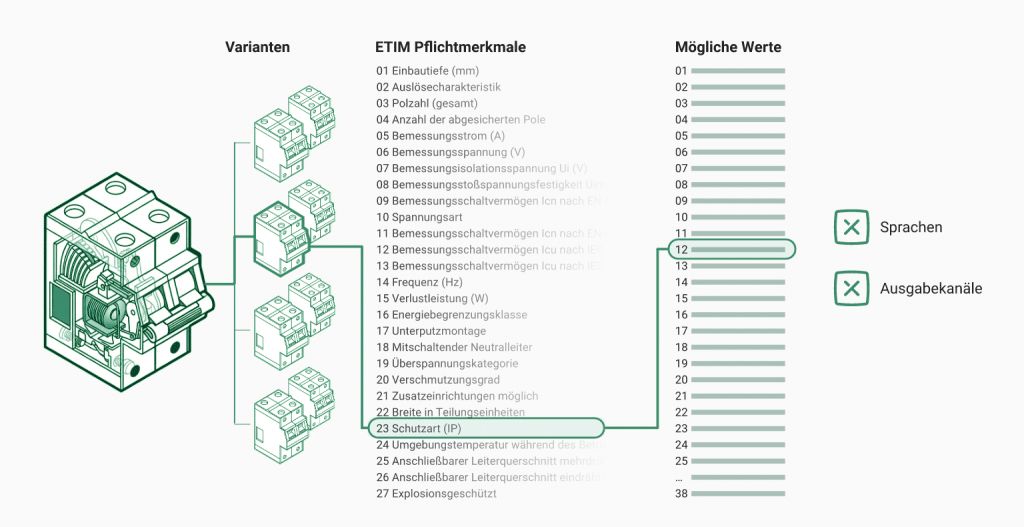
example:
Consider a seemingly straightforward product: a miniature circuit breaker. In the corresponding ETIM class EC000042, ETIM 10.0 alone specifies 27 mandatory features — rated current, tripping characteristic, number of poles, degree of protection, and more. For degree of protection alone, 38 possible values are defined. Multiply this across a typical product family with multiple variants, multiple languages, and multiple target systems, and the maintenance effort quickly becomes unmanageable with manual processes.
Four typical problems emerge:
What a Modern PIM/DAM System Must Deliver
A combined PIM/DAM system — a platform that unites Product Information Management and Digital Asset Management in a single interface — is the structural answer to the three forces described above. The operative word here is « combined »: separate systems don’t solve the problem, they merely relocate it. What’s needed is a single source that feeds all channels.
For the electrical engineering sector, four core capabilities define what such a system must deliver.
1. Classification Engine for Multiple Worlds and Versions
The baseline requirement: maintain ETIM, ECLASS, and UNSPSC in parallel; cleanly manage multiple ETIM versions side by side; automatically display mandatory features per class; and validate value lists against the standard.
In mediacockpit, this is handled through the e-proCAT module: the latest ETIM version is maintained, and older versions are derived from it. The system can automatically cross-classify between classification systems and versions at an automation rate of 70 to 80 percent.
Practical benefit: if ETIM 10 is maintained in the system and a distributor still requires ETIM 9, there’s no need to maintain both in parallel. The system derives the older version. If ETIM xChange 2.0 is needed as an output format, no platform migration is required — the export is a configuration task, not a migration project.
2. Integrated Asset Management for Media and Documents
A complete product data record in the electrical engineering sector encompasses many things: data sheets, installation manuals, wiring diagrams, EPLAN macros, 3D models, declarations of conformity, ATEX certificates, product images, and explainer videos.
A genuine PIM/DAM system doesn’t manage these assets separately — it links them directly to the relevant products.
This fundamentally changes the quality of data maintenance: when a certificate is updated, it’s updated in one place, and every channel that references that certificate automatically receives the current version. No version gaps between the online catalog and the print catalog; no manual distribution of PDF attachments to distributors.
3. Certificate and Compliance Management with Expiration Monitoring
This may be the most pressing capability for many manufacturers — and simultaneously the most underestimated.
A modern PIM/DAM system enables expiration dates to be stored directly on the certificate, and the system to automatically flag alerts when a certificate is due to expire within a configurable number of days.
In practice, this means: on Monday morning, a report arrives in the inbox listing which certificates are about to expire, along with which products are affected. If needed, the system can additionally be configured to automatically exclude a product from the next data delivery to a distributor the moment a mandatory certificate has lapsed — preventing a delisting caused by a missed renewal.
« When a distributor says: ‘I can’t accept your data in this state,’ a data problem very quickly becomes a revenue problem. »
 Alexander Caro, Head of Sales, Bertsch Innovation
 4. Multi-Channel Publishing from a Single Source
Every channel has its own format requirements and its own update cadence — whether the wholesale pool, CAD platforms, BIM portals, a branded microsite, or a print catalog for specialist retailers.
A PIM/DAM system with a mature publishing engine addresses this through assortments and publication profiles: the distributor receives their ETIM-compliant BMEcat with all technical attributes. The branded microsite receives SEO texts and images via the REST API. The specialty retailer receives print-ready layouts for their assortment catalog. All from the same data source.
This capability has a second, strategically important effect: manufacturers who are visible exclusively through wholesale have no direct relationship with the installer, the planner, or the architect. A branded microsite, a data sheet portal with CAD downloads, and a print catalog for specialty retail create direct brand touchpoints with the end customer — all fed from the same source that’s already being maintained for the wholesale channel.
The Digital Product Passport: Not a New PDF, But a New Data Problem
In many discussions, the Digital Product Passport (DPP) is still treated as an abstract future topic. That impression obscures the urgency: for specific batteries, the DPP obligation takes effect on February 18, 2027. For electronics and energy-related products, the roll-out follows from 2028.
What many underestimate: the DPP is not a document. It is a structured data container per product that brings together material composition, CO₂ footprint, recyclability, certificates, declarations of conformity, and sustainability information in machine-readable form.
Companies still managing their data in email inboxes, SharePoint folders, and Excel spreadsheets today will be facing a major clean-up project in 2027 — on top of their regular day-to-day workload.
By contrast, companies that have already built a centralized data foundation with structured compliance attributes will have most of the work already done.
The DPP export then becomes a configuration task: which fields from the PIM get mapped to the DPP format? What’s still missing and needs to be added? That’s a contained extension project — as opposed to the alternative, which requires all information to be gathered, cleaned, and structured from scratch.
The Core Message on the DPP
Companies that begin structuring their product data today are not just investing in a compliance obligation arriving in 2027. They are investing in operational efficiency that takes effect immediately — and they will be regulatorily ready in 2027 without a costly, time-intensive special project.
What Changes After Implementing mediacockpit
For electrical equipment manufacturers who have implemented mediacockpit, the changes can be distilled into five concrete outcomes.

Shorter time-to-market: Classification, translation, and channel export run in parallel rather than sequentially. Typical observation: significantly shorter lead time from ERP setup to BMEcat listing.

Secure wholesale listings: Data quality reporting surfaces gaps before a rejection arrives. Required field checks before every export prevent incomplete records from leaving the building.

Less manual data maintenance:Hot folder imports, background processes, and workflow integrations replace Excel-and-email loops, freeing up significant time.

Control over certificates and compliance: Expiration dates are monitored systemically. No delistings from missed certificate renewals; no surprises at the next compliance audit.

Own brand visibility: Microsites, print catalogs, and data sheet portals are fed from the same source. The manufacturer becomes directly visible to the planner, the architect, and the installer — not just in the wholesale catalog.
— Head of Marketing & Digital, premium brand for architectural lighting —
Act Now — Before the Pressure Becomes a Crisis
Product data has long been treated as a back-office concern. Necessary, but not strategically important. That era is over.
- ETIM classification determines listing or delisting.
- Certificate management determines whether products can be sold at all.
- The Digital Product Passport comes with a concrete deadline attached.
The good news: building a centralized data foundation today doesn’t just solve a compliance problem. It simultaneously resolves the data chaos that costs operational efficiency, and it creates the foundation for direct brand touchpoints beyond the wholesale catalog.
With a current, well-maintained data foundation, companies are ready for ETIM xChange 2.0, the Digital Product Passport, and every standard that follows.
How does your organization stack up?
We’ll show you in a personalized live demo how mediacockpit addresses your specific challenges in the electrical engineering sector — from ETIM classification and certificate management through to the Digital Product Passport.


Sebastian Hummel

Highlighted Whitepaper
ePaper: Strategic Product Content Management with PIM & DAM
Comment optimiser la gestion du contenu produit pour un succès à long terme : Découvrez comment rationaliser vos flux de travail avec PIM et DAM. Notre livre blanc offre des informations pratiques et des stratégies éprouvées pour vous aider à mettre en place une approche évolutive, efficace et pérenne de la gestion du contenu produit.
Accomplir plus ensemble
Nous croyons en la valeur de la collaboration et de l’échange. Cela s’applique aussi bien à nos projets clients, desquels nous tirons de nombreuses informations précieuses pour le développement de nos produits, et à notre réseau de partenaires en pleine expansion, avec lequel nous soutenons nos clients dans leur numérisation.